The Knowledge That Leaves When They Do: Engineering Succession Before the Expertise Is Gone
Ask the senior process engineer at almost any American manufacturing facility to explain why a particular parameter on a legacy production line is set the way it is, and you will frequently receive an answer that begins with some version of: "We tried it the other way in 1987, and it destroyed a batch." The parameter exists not because any document specifies it, but because one person remembers what happened when it was different — and that memory has quietly become load-bearing infrastructure for the entire operation.
This is tribal knowledge: the accumulated understanding of why things work the way they do, held not in documentation systems but in the minds of the people who were there when the decisions were made. And across US manufacturing, that knowledge is approaching a demographic cliff.
The Bureau of Labor Statistics has consistently reported that the manufacturing workforce is aging faster than it is being replaced. The American Society for Engineering Education has documented persistent shortfalls in engineering talent entering industrial sectors. The practical consequence is that a significant portion of the operational intelligence keeping American production lines running is concentrated in employees who are five to ten years from retirement — and in many cases, no structured plan exists to transfer what they know before they leave.
Why Documentation Alone Is Insufficient
The instinctive organizational response to knowledge retention risk is documentation: capture the expert's knowledge in a manual, a procedure, a work instruction. This approach is necessary but profoundly incomplete.
The problem is that the most valuable knowledge held by experienced engineers is not the kind that translates cleanly into written procedures. It is diagnostic intuition — the ability to hear an anomaly in a machine's operating sound and recognize it as the precursor to a specific failure mode. It is contextual judgment — knowing that a particular material behaves differently in summer humidity than in winter dryness, and adjusting process parameters accordingly without being told to. It is pattern recognition built over decades of problem-solving that cannot be fully decomposed into a checklist.
Cognitive science research on expert knowledge consistently finds that experts themselves often cannot fully articulate what they know. The knowledge is encoded in ways that are not directly accessible to conscious description. This is not evasiveness — it is the nature of deep expertise. Which means that asking an experienced engineer to write down everything they know will capture the explicit surface of their knowledge while leaving the most operationally critical elements undocumented.
A Framework for Structured Knowledge Transfer
Effective knowledge succession requires a methodology that goes beyond documentation to capture the tacit, contextual, and diagnostic dimensions of engineering expertise.
Identify the knowledge that matters most. Not all institutional knowledge carries equal operational risk if lost. Begin with a structured risk assessment: which processes, systems, or problem-solving domains are most dependent on specific individuals? Where does the organization's ability to maintain quality, diagnose failures, or execute complex setups reside in a single person? Prioritize knowledge transfer efforts based on both the criticality of the knowledge and the retirement proximity of the holder.
Use structured elicitation, not open-ended interviews. The most effective knowledge capture techniques are those that present the expert with concrete scenarios, historical cases, and specific decision points rather than asking them to describe their knowledge abstractly. Walk through actual failure cases together. Ask the expert to narrate their diagnostic reasoning as they work through a real problem. Have them evaluate hypothetical scenarios and explain their reasoning at each decision point. This scenario-based approach surfaces the contextual judgment and diagnostic heuristics that abstract interviews miss.
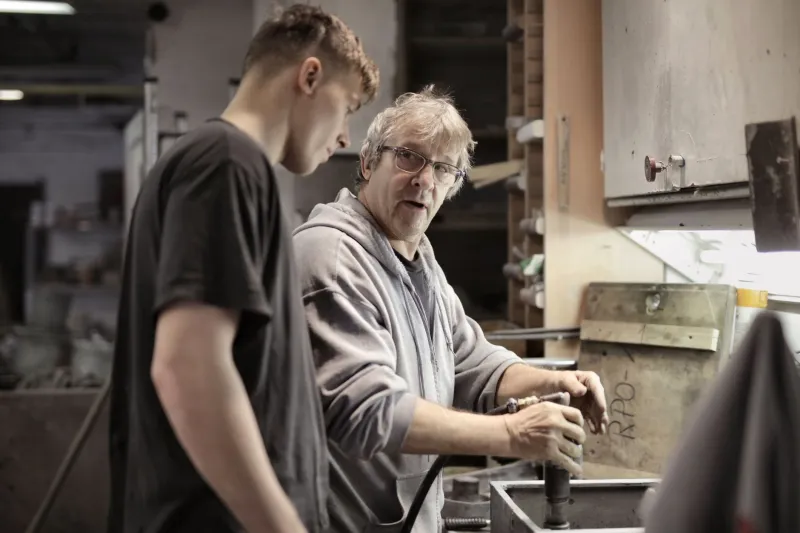
Create apprenticeship structures, not just training programs. Formal training programs transfer explicit knowledge — procedures, specifications, technical theory. Apprenticeship transfers tacit knowledge through direct observation, guided practice, and mentored problem-solving. Assigning junior engineers to work alongside senior experts on actual production challenges — not in a training environment but in live operational contexts — is the most reliable mechanism for transmitting the knowledge that cannot be written down.
This requires organizational commitment to protect the time of senior engineers for mentorship activities, which often competes with their operational responsibilities. That trade-off is real. It is also significantly less costly than the alternative.
Document the reasoning, not just the outcome. When experienced engineers do produce written documentation, the most valuable content is not the procedure itself but the reasoning behind it — the historical context, the failure modes that specific steps are designed to prevent, the conditions under which standard procedures require judgment-based modification. A work instruction that says "set parameter X to value Y" is less useful than one that explains why value Y was chosen, what happens when it drifts, and how to recognize the early signs that it needs adjustment.
Build redundancy into critical knowledge domains. Single-expert dependencies are the highest-risk configuration. Where one person is the sole organizational repository for critical knowledge, the succession plan must include creating at least one additional qualified practitioner before the primary expert departs. This is not duplication of effort — it is elimination of a single point of failure.
The Technology Dimension
Digital tools offer meaningful support for knowledge succession, though they are not substitutes for the human transfer processes described above. Video documentation of complex procedures — capturing not just the steps but the expert's commentary on what to look for, what variations are acceptable, and what signals indicate problems — preserves contextual information that written procedures cannot. Knowledge management platforms that allow experts to annotate historical records, tag documents with decision rationale, and build searchable case libraries extend the reach of institutional knowledge beyond individual memory.
Digital twin environments, where available, provide a particularly valuable context for knowledge transfer: junior engineers can interact with a virtual representation of complex systems, explore failure scenarios, and build diagnostic intuition in an environment where mistakes carry no operational consequence.
These tools are most effective when they are deployed as part of a structured knowledge succession program rather than as standalone initiatives.
The Cost of Waiting
Organizations that delay knowledge succession planning until after a key engineer retires discover the cost in the most direct way possible: production problems that used to take hours to diagnose take days. Process adjustments that were once intuitive require expensive external consultation. Equipment failures that a former employee would have anticipated recur because no one currently on staff carries the pattern recognition to prevent them.
The knowledge that experienced engineers hold has been built over careers spanning decades. Transferring it effectively requires time — time for structured elicitation, time for apprenticeship, time for documentation and validation. That time must be invested before the retirement clock runs out, not after.
Apex Engineering Solutions supports industrial manufacturers in designing and implementing engineering knowledge succession programs — from risk assessment and knowledge mapping through structured elicitation, documentation architecture, and mentorship program design. The expertise your operation depends on today represents an asset worth protecting. We can help you build the transfer infrastructure to keep it.