Sunk Costs and Second Lives: The Hidden Economics of Mid-Life Equipment Upgrades

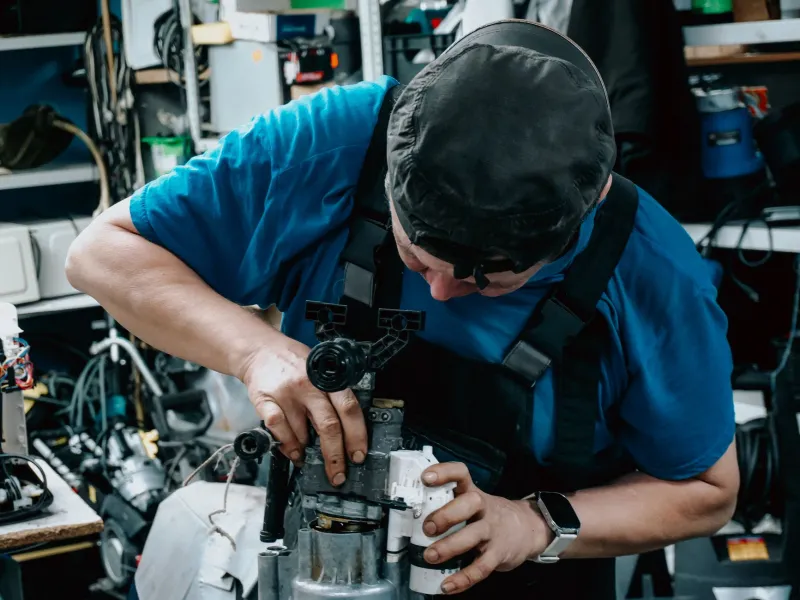
Photo: industrial equipment retrofit upgrade manufacturing plant machinery, via i.pinimg.com
When a piece of capital equipment reaches the midpoint of its service life, plant managers and engineering teams face a decision that carries consequences far beyond the immediate budget cycle. The instinct to retrofit—to modernize what already exists rather than invest in a full replacement—is understandable. Capital expenditure approval processes are demanding, equipment downtime during replacement is disruptive, and the familiar argument that "it still runs" carries real weight in production environments under pressure to minimize spending.
But that argument has limits. And in a surprising number of documented cases across American manufacturing, those limits are reached only after retrofit projects have already overrun their original estimates by substantial margins.
Why Retrofitting Looks Attractive—and Where the Logic Breaks Down
The financial case for retrofitting typically begins with a straightforward comparison: the cost of a modern control system upgrade or mechanical refurbishment versus the capital outlay for a new machine. On a spreadsheet, the retrofit frequently wins. It preserves the structural investment already made in the base equipment, avoids the lead times associated with new procurement, and sidesteps the political difficulty of justifying full replacement to financial stakeholders.
The problem is that this comparison rarely accounts for what engineers encounter once the work begins.
Aging industrial platforms were not designed with future modernization in mind. A CNC machining center manufactured in the early 2000s, for instance, may have a mechanically sound frame and spindle assembly, but its electrical architecture, communication protocols, and safety interlocks were built to standards that have since been superseded. Integrating a modern PLC or HMI into that infrastructure is rarely plug-and-play. It requires custom interface development, signal translation layers, and in many cases, the replacement of additional subsystems that were never budgeted in the original scope.
This is the first hidden cost: scope expansion. In retrofit projects, the initial engineering assessment often fails to capture the full extent of legacy system dependencies. Each newly discovered incompatibility triggers an additional work order, and those work orders accumulate.
The Compatibility Problem in Practice
Consider the experience of a mid-sized precision components manufacturer in the Midwest that undertook a control system retrofit on a horizontal machining center rather than replacing it with a new platform. The original estimate covered the new control hardware, installation labor, and a two-week commissioning period. What it did not account for was the discovery that the machine's servo drives used a proprietary communication protocol no longer supported by the new control vendor. Bridging that gap required a third-party integration module, extended commissioning time, and a software development engagement that had not appeared in the original scope of work.
By the time the machine returned to production, the retrofit had cost approximately 78 percent of what a new equivalent machine would have cost—without the warranty, the updated safety certifications, or the energy efficiency of a modern platform.
This outcome is not unusual. Engineering assessments conducted after the fact on failed or overrun retrofit projects consistently identify the same pattern: initial estimates capture visible costs while underestimating the investigative and remediation work triggered by legacy architecture.
Training and Workforce Transition Costs Are Consistently Underestimated
Beyond the hardware and integration challenges, retrofitted equipment frequently creates a workforce transition burden that budget models fail to quantify accurately. When a new control interface is installed on a familiar machine platform, operators and maintenance technicians face a hybrid environment: the physical behaviors they know, combined with control logic they do not. This combination can be more disorienting than learning a fully new system, because it disrupts established mental models without fully replacing them.
Training programs for hybrid retrofitted systems require more customization than standard OEM training packages, which are designed for new platforms. They must address both the legacy mechanical behavior and the new control environment simultaneously. In facilities where skilled maintenance personnel are already stretched thin—a condition that describes a significant portion of American industrial operations today—this training burden adds meaningful cost and extends the timeline before the retrofitted asset reaches full productivity.
A Framework for Making the Decision Correctly
None of this argues that retrofitting is always the wrong choice. There are legitimate scenarios in which a well-scoped, carefully executed retrofit delivers genuine value. Equipment with robust structural components, straightforward upgrade paths, and modern-compatible subsystems can often be modernized efficiently. The key is that the decision must be made on the basis of rigorous engineering assessment rather than surface-level cost comparison.
Engineering teams evaluating a retrofit versus replacement decision should apply a structured framework that addresses several critical dimensions:
Total Integration Cost Assessment. Before any retrofit commitment is made, a qualified engineering team should conduct a full audit of the existing platform's electrical, mechanical, and software architecture. The goal is to identify every subsystem that will require modification or replacement to support the intended upgrade—not just the primary target system.
Lifecycle Position Analysis. A machine at 60 percent of its design life presents a different risk profile than one at 85 percent. Retrofitting a platform that is approaching end-of-life on its structural components transfers modernization cost onto a foundation that may require additional intervention within a few years.
Opportunity Cost Accounting. The comparison should not be limited to retrofit cost versus new equipment cost. It should also account for the productivity differential between a modernized legacy platform and a new system, the downtime risk associated with the retrofit process itself, and the long-term maintenance cost trajectory of each option.
Vendor Support Horizon. For any retrofit involving new control hardware or software, engineering teams should verify the vendor's committed support horizon for the components being installed. Installing a control system with a five-year support window on a machine intended to run for fifteen years simply defers the modernization problem.
The Decision Is an Engineering Problem, Not a Finance Problem
The most persistent mistake organizations make when evaluating mid-life equipment upgrades is allowing the decision to be driven primarily by capital budget constraints rather than engineering reality. Finance teams are not positioned to assess integration complexity, legacy architecture risk, or the true scope of workforce transition requirements. When those variables are excluded from the analysis, retrofit decisions are made on incomplete information—and the cost overruns that follow are predictable.
American manufacturers operating in competitive markets cannot afford to treat capital equipment decisions as opportunities to defer difficult choices. The retrofit gamble, when it fails, consumes not just budget but time, production capacity, and engineering attention that could have been directed toward genuine operational improvement.
The right answer—retrofit or replace—depends entirely on the specifics of the equipment, the upgrade scope, and the operational context. But that answer must be derived from a disciplined engineering assessment, not from the comfort of a lower initial number on a comparison spreadsheet.